The day I discovered what kind of man I had become began with a stranger's blanket lying in a puddle.
I was thirty-five years old, wearing a navy designer suit that cost more than some people earned in a month, and I was already late for an important meeting.
Rain hammered the city streets, turning the sidewalks into shallow rivers and making every passing car spray dirty water against the curb.
I had stopped beneath the shelter of a bus station to check a message on my phone when an elderly homeless man shifted on the bench beside me.
His name was Walter, though I wouldn't learn that until later.
He had tangled gray hair, a weathered beard, and a brown coat so worn that the elbows had nearly split open.
A battered wooden cane leaned against his knee, and an old gray blanket lay folded beside him.
When he moved to make room for another passenger, the edge of his coat brushed my trousers.
It was barely a touch.
But I looked down at the damp mark on my expensive suit and reacted as though he had deliberately ruined my entire life.
"Keep your filthy hands away from me!"
Walter immediately pulled back.
"I'm sorry, sir," he said quietly. "I didn't mean to—"
I didn't let him finish.
I grabbed the gray blanket from the bench and flung it into the street.
It landed in a puddle beside the curb, splashing muddy water across the fabric.
Walter stared at it in disbelief.
For a second, even I could see how cruel the gesture had been.
Then pride stepped in and did what pride always does when it knows it is wrong.
It convinced me that I had every right to be angry.
"People like you shouldn't be here," I muttered, straightening my jacket.
A woman waiting beneath the shelter looked at me with open disgust.
A young man standing near the timetable lowered his phone but kept watching.
I noticed both of them.
I simply decided their opinions didn't matter.
Walter gripped his cane and slowly pushed himself to his feet.
His knees seemed to struggle beneath him, and the rain had soaked through his coat, but he didn't ask anyone for help.
He took one careful step toward the curb, bent forward, and reached for the blanket.
The puddle was deeper than it looked.
When his fingers caught the wet fabric, his cane slipped against the slick pavement.
He stumbled, caught himself against the bus shelter, and tried again.
I watched him struggle.
I could have picked up the blanket in two seconds.
I could have apologized.
Instead, I checked my watch.
That was the moment I should have been ashamed of myself.
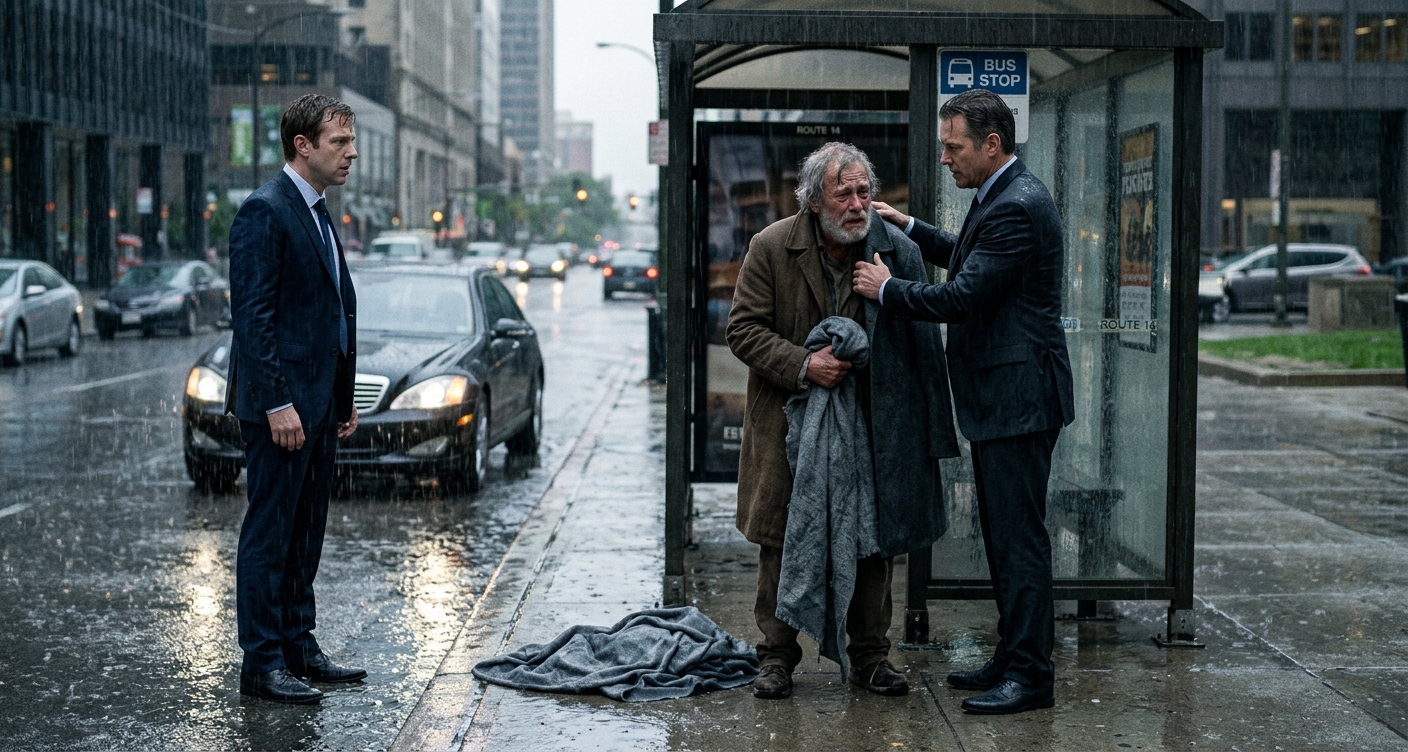
The moment I should have understood that being in a hurry did not make me more important than the man standing in the rain.
But I walked a few steps away and pretended to check my phone.
Then a black luxury sedan pulled up beside the bus stop.
It was a long, polished car with dark windows and a warm amber glow inside, the sort of vehicle that made people turn their heads even in terrible weather.
The driver slowed carefully beside the curb and stopped.
I recognized the car immediately.
My stomach tightened.
The rear door opened, and a man in a charcoal suit stepped out into the rain.
He was around fifty, with neatly trimmed salt-and-pepper hair and a face that seemed calm even when the weather was trying to tear the city apart.
His name was Alexander Bennett.
And he was my father.
He had spent decades building a successful construction and property management company, beginning with a small contracting business and expanding it into one of the most respected firms in the region.
I had grown up watching people treat him differently depending on how much money they believed he had.
Some admired him.
Some feared him.
Others smiled too eagerly whenever he entered a room.
I had learned the wrong lesson from all of it.
I believed that wealth made a person superior.
My father had spent years trying to convince me otherwise.
I had spent years proving that I wasn't listening.
That morning, he didn't even glance in my direction.
His eyes went straight to Walter.
The old man had finally dragged his blanket out of the puddle.
It hung from his hands, heavy with dirty rainwater, and he was trying to shake it dry beneath the shelter.
My father crossed the sidewalk without hesitation.
He removed his dark suit jacket and gently draped it over Walter's shoulders.
Walter flinched at first, as though he expected another insult.
Then he looked up.
"Sir, you don't have to do that," he said, his voice trembling. "You'll get soaked."
My father adjusted the jacket around him.
"I'm already wet," he replied. "You look like you need it more than I do."
Walter stared at him.
The rain ran through his beard, and his eyes filled with tears he seemed embarrassed to show.
"Why would you do this for me?"
My father met his gaze.
"Because you deserve kindness."
I felt something uncomfortable shift inside my chest.
It wasn't guilt yet.
Guilt would have required me to admit that I had done something wrong.
At that moment, I was still searching for a way to convince myself that the situation wasn't as bad as it looked.
Perhaps my father hadn't seen what happened.
Perhaps Walter had somehow offended me.
Perhaps there was an explanation that would make me the reasonable person in the story.
Then my father finally turned toward me.
"Ryan."
He said my name quietly.
That was worse than if he had shouted.
I stood beside the shelter with rain dripping from the edge of my hair.
"Father," I replied, forcing a smile. "I didn't know you were coming this way."
"I can see that."
His eyes moved from my dry shirt collar to Walter's soaked blanket.
Then he looked at the puddle.
"What happened here?"
I glanced at the people watching us.
"Nothing serious. He got too close, and I was trying to keep my clothes clean."
My father said nothing.
I mistook his silence for an opportunity.
"He shouldn't be sitting right next to people like this," I added. "There are proper places for—"
"People like what?"
The question stopped me.
I looked at him.
He wasn't angry in the way I expected.
He seemed disappointed, and somehow that made me feel smaller than any public reprimand could have.
I swallowed.
"You know what I mean."
"No," he said. "I want to hear you say it."
The woman beneath the shelter folded her arms.
Walter stood quietly beside my father, clutching the soaked blanket against his chest.
I suddenly became aware of how many people had watched me throw it into the puddle.
"I didn't want him touching my suit," I said.
"So you threw away his blanket?"
"It was just a blanket."
My father looked down at the waterlogged fabric.
Then he looked back at me.
"To you."
I had no answer.
He turned toward Walter.
"Do you have somewhere warm to go tonight?"
Walter hesitated before answering.
"Sometimes I stay at the shelter on Mercer Street. If they have room."
"And if they don't?"
Walter gave a small, tired shrug.
"I find somewhere dry enough."
My father closed his eyes for a moment.
When he opened them, something in his expression had changed.
"Come with me," he said. "We'll get you somewhere warm, have you checked by a doctor, and find out what help you need."
Walter looked uncertain.
"I don't want to cause trouble."
"You aren't causing trouble."
My father offered him an arm.
Walter accepted it carefully, and together they started toward the car.
I followed them, unable to understand why my father was giving so much attention to a stranger.
As we reached the rear door, I finally found my voice.
"You're really going to put him in your car?"
My father turned.
"Yes."
"Father, look at him. He's soaked."
My father glanced at Walter's borrowed jacket, then at me.
"Exactly."
The word landed like a slap.
He opened the car door and helped Walter sit down.
Before closing it, he folded the wet blanket carefully and placed it on a towel the driver had brought from the trunk.
Walter thanked him twice.
My father told him he didn't need to.
Then he looked at me again.
"Get in, Ryan."
I obeyed.
Inside the car, the heater hummed softly, and rain tapped against the windows.
Walter sat beside my father, wrapped in the charcoal jacket, holding his blanket on his lap as though he was afraid someone might take it away.
I sat across from them, trying to ignore the dirty water on the floor mat.
My father gave the driver an address for a nearby medical clinic that worked with a local outreach organization.
Then he made a phone call to arrange a warm meal and a place for Walter to stay.
He didn't ask Walter to tell his story in exchange.
He didn't photograph him.
He didn't announce his generosity to anyone.
He simply handled the problem in front of him.
That was the first time I understood how little I knew about the man who had raised me.
When the call ended, Walter began apologizing for the state of the car.
My father shook his head.
"Don't apologize for being caught in the rain."
Walter looked down at his hands.
"I used to have a home," he said after a long silence. "A wife, too. She passed away three years ago. After the medical bills and losing my job, I couldn't keep the apartment."
He spoke without asking for sympathy.
He described how one difficult year had turned into another, how temporary work had become harder to find, and how a string of bad luck had gradually stripped away the things he once thought were permanent.
He had a daughter, he explained, but they hadn't spoken in years after a bitter argument.
He didn't blame her.
He didn't blame anyone.
He only wanted a safe place to sleep and a chance to get back on his feet.
I stared out the window.
Every word made my behavior at the bus stop feel uglier.
I had treated Walter as though his worn clothes were proof that he was worth less than me.
I had never asked what had happened to him.
I hadn't even considered that he might have once worn a fine suit of his own.
When we arrived at the clinic, my father helped Walter out of the car.
Before they entered, he turned to me.
"Wait here."
I watched through the window as my father spoke with the clinic staff and made sure Walter was admitted.
He stayed beside the old man until someone brought him a dry change of clothes.
Then he returned to the car alone.
I expected a lecture.
Instead, he sat down and looked at me for a long time.
"Do you know why I stopped when I saw him?"
I shook my head.
"Because I recognized him."
I frowned.
My father explained that he had met Walter several years earlier at a community center where his company had been helping renovate a kitchen.
Walter had volunteered there, serving meals and repairing broken chairs despite having very little himself.
He had been living in a small rented room at the time and had spent much of his spare time helping older people who couldn't manage on their own.
When his circumstances worsened, he gradually disappeared from the center.
My father had asked around but hadn't been able to find him.
"He's the kind of man who helped people even when he had almost nothing," my father said. "And today, when I found him again, you were throwing his blanket into the street."
I lowered my eyes.
"I didn't know who he was."
My father leaned back.
"Would that have made it acceptable if you had known nothing about his past?"
I couldn't answer.
"Would you have treated him differently if he had been a millionaire wearing an expensive watch?"
The silence in the car seemed to grow heavier.
Finally, I whispered, "I was wrong."
My father didn't congratulate me for saying it.
He didn't tell me everything was fine.
He simply nodded.
"Then do something about it."
That afternoon, I returned to the bus station.
The rain had weakened to a steady drizzle, and the sidewalk still glistened beneath the gray sky.
I carried a new blanket in a paper bag, along with a warm coat I had purchased on the way.
I had no idea whether Walter would want to see me.
Part of me hoped he wouldn't be there.
That would have allowed me to tell myself that I had tried, then quietly move on.
But he was sitting on the same bench, wearing dry clothes supplied by the clinic.
When he saw me approaching, his expression became guarded.
I stopped several feet away.
"Mr. Walter?"
He looked at me without speaking.
"My name is Ryan. I'm the man who threw your blanket into the puddle this morning."
His eyes narrowed slightly.
"I remember."
I deserved that answer.
I placed the bag on the bench between us.
"I brought you a new blanket and a coat. It's not enough to make up for what I did, but I wanted to bring them to you myself."
Walter looked at the bag.
Then he looked at me.
"Did your father tell you to come?"
The question hurt because I couldn't honestly say that he hadn't influenced me.
"He told me to do something about what I'd done," I admitted. "But I'm here because I should have known better in the first place."
Walter remained silent.
I forced myself to continue.
"I treated you like you weren't worth basic respect because your clothes were old and mine were expensive. I was cruel to you, and I'm sorry."
The words felt unfamiliar in my mouth.
Not because I had never apologized before, but because I had rarely apologized without immediately searching for a way to defend myself.
Walter finally reached for the bag.
"Thank you," he said.
I nodded, relieved but not forgiven.
Then he added something I have never forgotten.
"Son, a man can lose his home, his job, his family, even his health. But the hardest thing to lose is the feeling that other people can still see him."
I stood there in the drizzle, unable to speak.
He wasn't asking me to feel sorry for him.
He was telling me what I had taken away for a few cruel minutes.
I offered to help him contact the community center where my father had first met him.
Walter agreed, and over the following weeks, my father and I helped him reconnect with the people who had known him before his life fell apart.
The outreach organization arranged temporary housing and helped him replace the identification documents he had lost.
My father also asked his company to review its existing partnerships with local shelters and job-placement programs.
I began volunteering at the community center on Saturday mornings.
At first, I felt awkward carrying boxes and serving meals beside people who had no reason to trust me.
I kept showing up anyway.
I learned names.
I listened to stories.
I discovered that homelessness was rarely a single event and almost never something that could be understood by looking at a person's coat.
Walter eventually found a modest room of his own.
He began helping at the center again, this time assisting with meal distribution and greeting newcomers who arrived looking as frightened and exhausted as he once had.
He never pretended that what I had done was harmless.
He simply allowed me the chance to prove that I could become a different kind of man.
Months later, I saw him walking along the sidewalk outside the center in a clean brown coat, carrying his old wooden cane.
I hurried over to greet him.
He smiled when he recognized me.
For the first time, I didn't think about the condition of my suit or whether anyone was watching.
I asked how he was doing.
He told me he was well, then asked whether I was still helping at the center.
When I said yes, he gave a small nod.
"Good," he said. "Keep going."
I have never forgotten the sight of that gray blanket lying in the muddy puddle.
It reminds me that cruelty often begins with something small: a glance, a sneer, the assumption that another person's suffering is an inconvenience.
And it reminds me that kindness doesn't require a grand gesture, a luxury car, or a wealthy man stepping out into the rain.
Sometimes it requires nothing more than refusing to look away.
I used to believe that a man's worth could be measured by the clothes he wore, the car he drove, and the doors that opened when he arrived.
Now I understand that the real measure is what he does when someone has nothing to offer him.
That morning, I had stood beneath a bus shelter in an expensive suit and believed I was better than a homeless stranger.
My father stepped out of a luxury car and showed me how wrong I was.
And the man I had tried to humiliate became the person who taught me what dignity actually looks like.