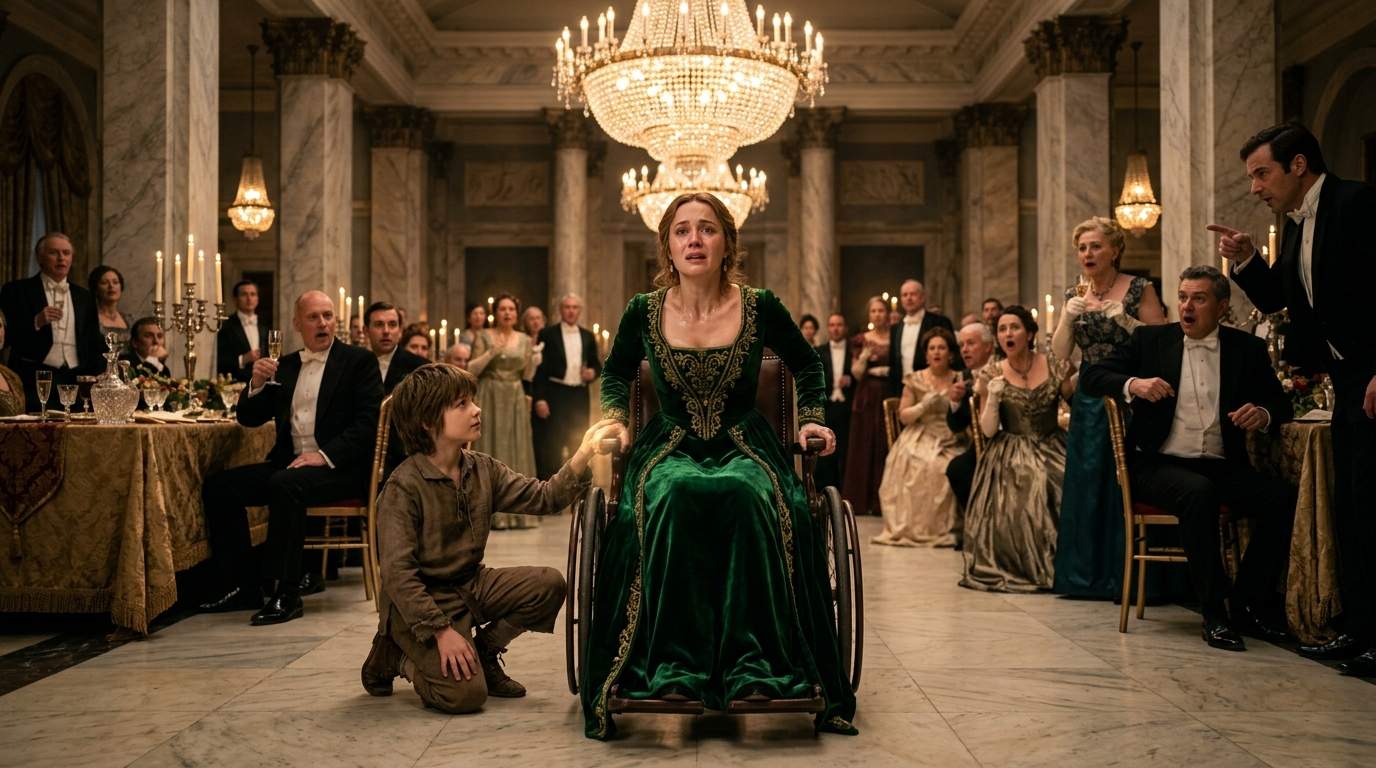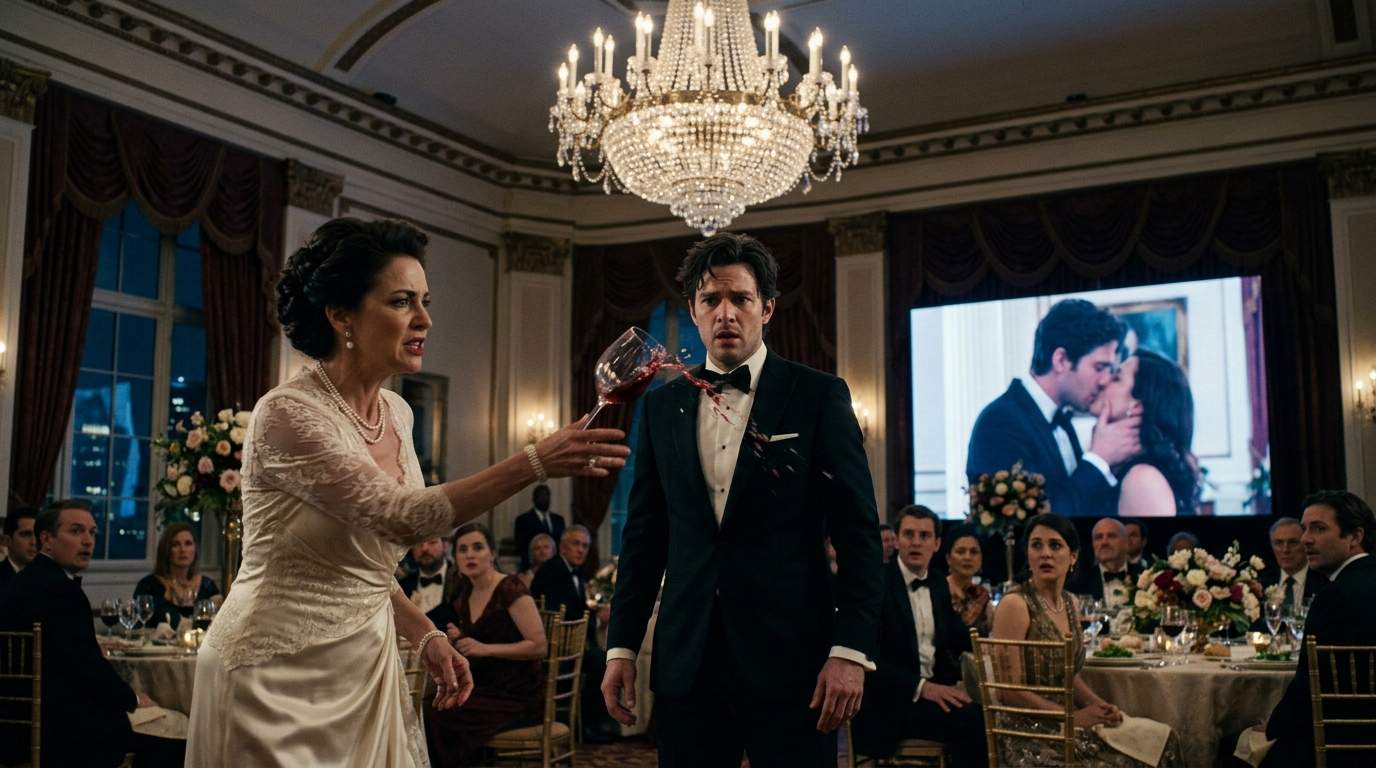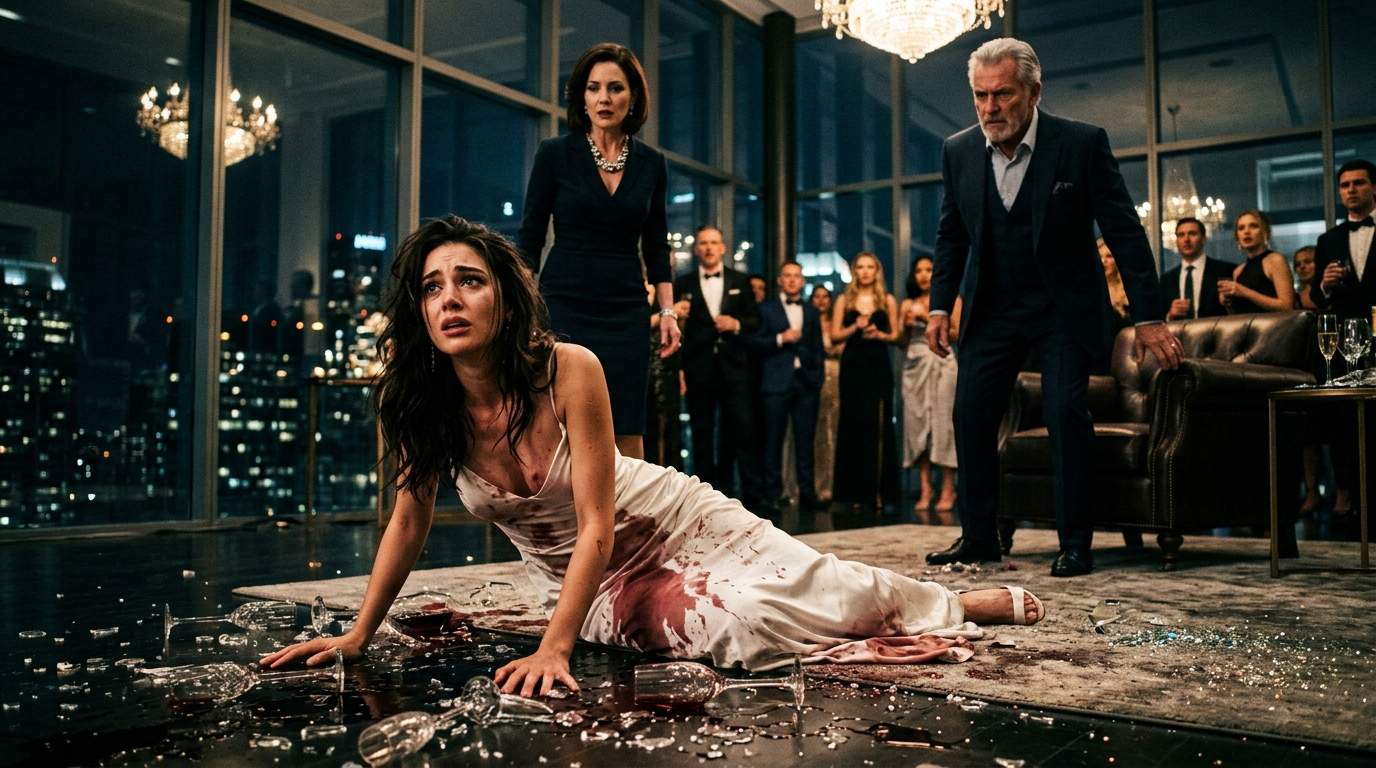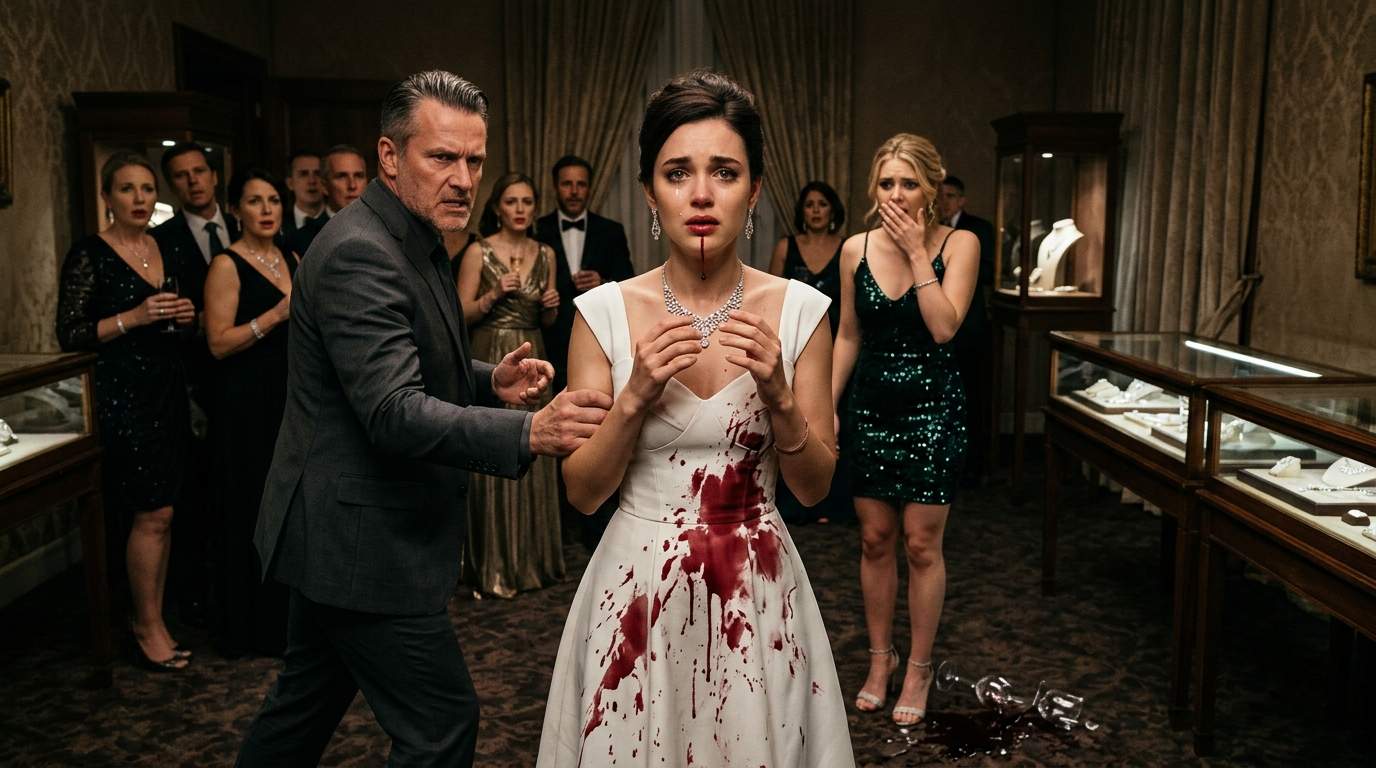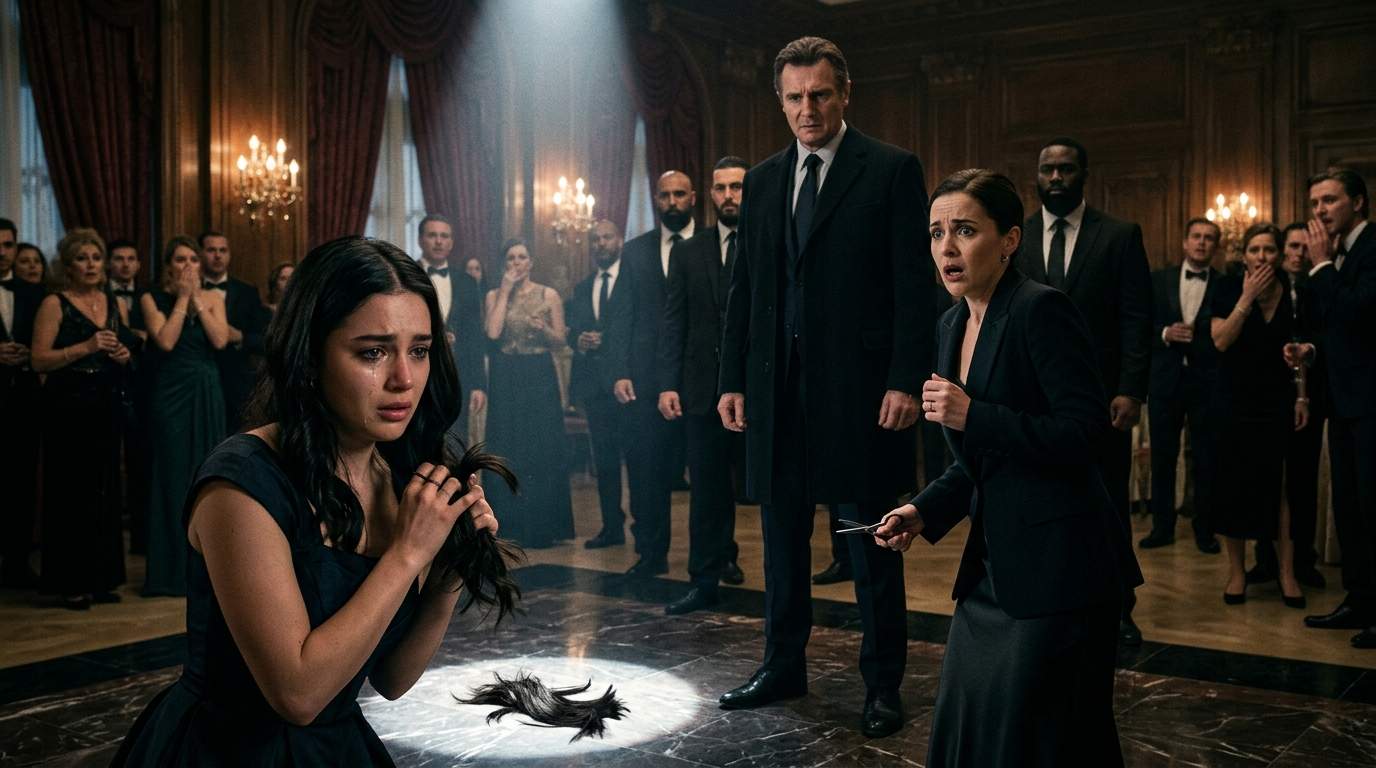
The massive crystal chandelier above the palatial ballroom cast a diamond glitter over the scene.
White roses climbed towering champagne racks, their fragrance mingling with the soft strains of a live band playing romantic melodies.
VIPs in haute couture evening gowns clinked glasses, their laughter echoing softly under the golden ceiling.
This was the wedding of Julian Thorne, the charismatic billionaire heir, and Eleanor Vance, the elegant old-money socialite.
On a giant LED screen, a romantic montage of the couple’s journey played, showcasing their curated perfect love story.
Then, an imperceptible hiccup in the digital stream.
The vibrant, sun-drenched images of their romantic memories abruptly switched.
A hush began to fall, slow and insidious, as guests noticed the change.
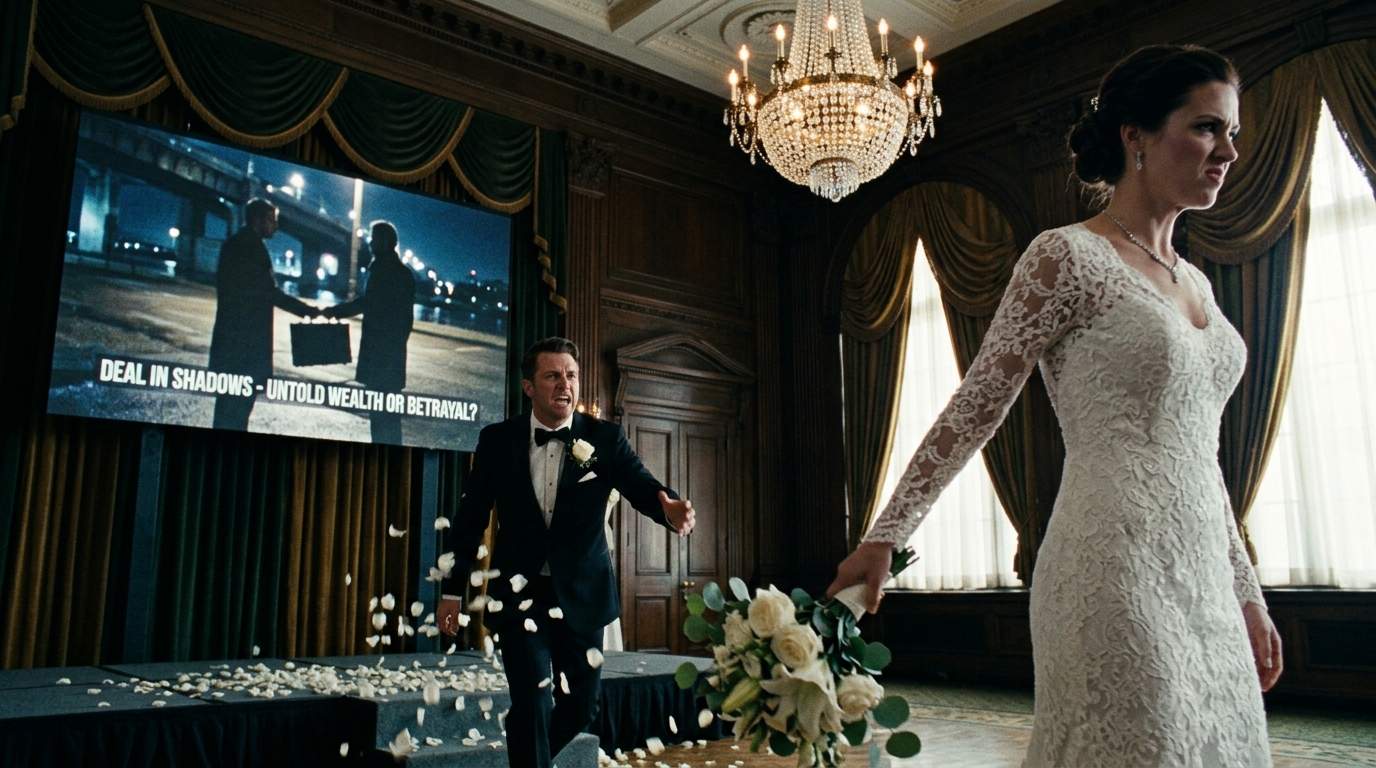
The screen now displayed a grainy, handheld video.
It showed Julian, not in the joyful settings from the montage, but in a dimly lit, nondescript room.
He stood opposite a figure whose face was obscured by shadow and a wide-brimmed hat.
A brief, tense exchange of words unfolded, impossible to hear over the ballroom's receding music.
Then, the glint of polished leather: a briefcase.
Julian meticulously handed it over, receiving a thick envelope in return.
As their hands brushed, a lingering touch, almost a caress, passed between Julian and the shadowy figure.
The intimacy was fleeting, ambiguous, yet undeniably unsettling.
On the stage, Julian’s practiced, confident smile froze instantly.
A cold dread washed over his features, eyes wide with a terror that ripped through his carefully constructed composure.
Eleanor, beside him, felt her own perfect, aristocratic smile crack like fine porcelain.
Her gaze snapped from the screen, where the incriminating scene continued to loop, to her husband’s ashen face.
“Julian,” she whispered, her voice barely audible, “what is this?”
The Golden Boy's Secret Empire
Julian Thorne had always played the part of the charming, privileged heir perfectly.
His family’s name, though old, had been burnished by his ruthless ambition and a calculated public persona.
He was seen as a visionary, a deal-maker, the man who could resurrect any ailing venture.
But beneath the polished veneer of the "golden boy" lay the heart of a shrewd conman.
His empire was built not just on inheritance, but on a labyrinthine network of shell corporations, dubious investments, and whispers of less-than-legal dealings.
The wedding to Eleanor Vance was not merely a love match; it was a strategic consolidation.
Her family's generational wealth and deep political influence were the final pieces Julian needed to stabilize his increasingly volatile financial house of cards.
Eleanor, for her part, was no naive socialite.
Born into a lineage that valued power and preservation above all else, she understood the mechanics of an advantageous alliance.
Her reserved demeanor masked a sharp intellect and an iron will.
She knew Julian was ambitious, perhaps even ruthless, but she believed she understood the game.
This marriage was a mutually beneficial contract, securing her family's legacy and granting Julian the social currency he craved.
Love, if it existed, was a secondary, pleasant side effect.
The Architect of Ruin: Vivienne Dubois
The woman behind the screen, however, was no jilted lover.
Vivienne Dubois was a ghost from Julian’s past, a specter of his ambition’s collateral damage.
Years ago, Julian’s intricate web of financial manipulations had swallowed her family’s entire legacy.
A fraudulent land deal, a collapsed investment fund, and a series of anonymous shell companies had left her family destitute and disgraced.
Her father, unable to bear the public humiliation and financial ruin, had died shortly after.
Vivienne had spent every waking moment since meticulously dissecting Julian’s empire.
She wasn't driven by petty revenge; her motive was justice, a complete and utter dismantling of the man who had destroyed her life.
She chose the wedding, the pinnacle of Julian’s curated public image, as the stage for his downfall.
The apparent "affair" was merely a carefully crafted Trojan horse.
The video, seemingly exposing infidelity, actually contained subtle clues and timestamps that, to a trained eye, pointed towards a far more sinister criminal enterprise.
The shadowy figure in the video was not Vivienne herself, but an unsuspecting intermediary involved in one of Julian’s illicit transactions.
Vivienne had simply ensured the recording captured that ambiguous, fleeting touch, knowing the immediate scandal of an affair would guarantee maximum attention and outrage.
It was designed to spark the public frenzy, allowing the deeper, more damning truth to emerge once the initial shock wore off.
The Unraveling Moment
The band’s romantic music, once a gentle backdrop, abruptly ceased, leaving a suffocating silence.
Guests slowly lowered their champagne glasses, their murmurs dying as every eye fixed on the screen.
The loop continued: Julian, the briefcase, the shadowy figure, the unsettling touch.
Whispers began to spread, hushed and horrified.
A few bold guests, sensing history in the making, discreetly raised their phones, eager to capture the unfolding chaos.
Eleanor watched the screen, her heart pounding not just with anger, but with a chilling realization.
The intimate touch was damning, certainly, but it was the briefcase, the clandestine nature of the meeting, that sent a colder dread through her.
This wasn't merely a romantic transgression; this was an exposure of something far more perilous to her family's name and fortune.
Julian, seeing the horrified faces, heard the rising tide of murmurs, and knew his perfectly constructed world was crumbling.
His breath hitched, a silent, guttural scream trapped in his throat.
He surged forward, a primal roar erupting from him, abandoning all pretense of decorum.
He lunged towards the giant screen, his hands outstretched, desperate to tear it down, to shatter the damning evidence.
Eleanor's Icy Fury
But the images continued to play, relentless and unforgiving.
Julian’s desperate efforts to destroy the screen only amplified his guilt in the eyes of the stunned onlookers.
He spun around, eyes wild, attempting to stammer out denials, explanations, anything to salvage his image.
No one listened.
All eyes, including Eleanor’s, remained fixed on the repeating footage.
Eleanor felt a profound, icy disappointment settle over her.
Her initial shock had transformed into a controlled, incandescent fury.
This wasn’t just a breach of marital vows; this was a betrayal of a carefully negotiated alliance, an unforgivable stain on her family’s revered reputation.
With a sharp intake of breath, she raised her hand, clutching her white rose bouquet.
Then, with a sudden, powerful movement, she hurled it to the ground.
The pristine white petals scattered like shattered dreams across the polished marble floor.
She turned then, not in a flight of tears, but with a regal, devastating dignity.
Her back stiff, her chin held high, she began to walk away from the stage, from the crumbling spectacle, from Julian.
She did not look back.
Julian stood frozen beneath the relentless glare of the screen, the image of his clandestine meeting mocking him.
His perfect public image had not just crumbled; it had exploded into a thousand irreparable shards.
The scene froze in a moment of cinematic horror: the massive exposure playing on the screen, the silent, wealthy guests, the utterly humiliated groom, and the angry, determined bride disappearing into the opulent shadows.
This was not the end of a wedding; it was the explosive beginning of a much larger, darker saga.