The Inheritance
Mark and Sarah had always dreamed of a quiet life.
Their love was simple, their ambitions modest.
When Mark’s late grandfather, Elias Thorne, left him his sprawling, secluded estate in his will, it felt like fate.
A fresh start, a new chapter, far from the city’s relentless pace.
Elias had been a brilliant, if eccentric, inventor, known for his reclusive nature and strange experiments in his later years.
Mark had mostly dismissed the family rumors as charming quirks of an old man.
“He was just… Elias,” Mark would chuckle to Sarah, shaking his head at stories of hidden workshops and late-night lights.
They moved in, Buster, their scruffy terrier mix, excitedly exploring every nook and cranny of the old house.
For the first few weeks, a gentle quiet settled over them.
But then, subtle irregularities began to emerge.
Faint, inexplicable creaks echoed from empty hallways after midnight.
Cold drafts seemed to snake through closed rooms.
Buster, initially playful, started exhibiting strange behavior.
He’d occasionally stop dead in his tracks, nose twitching, a low, guttural growl rumbling in his chest.
His gaze would fixate on seemingly empty corners, his hackles slightly raised.
Sarah, ever the worrier, tried to brush it off as the house settling, or Buster adapting to new surroundings.
Mark, pragmatic to a fault, agreed.
The Growing Obsession
The bedroom was their sanctuary, or so they thought.
One night, the unsettling atmosphere escalated dramatically.
Buster, who usually slept peacefully at the foot of their bed, suddenly shot up.
He launched himself at the wall opposite their bed, a plaster surface adorned with an old, faded landscape painting.
His barks were not playful yaps; they were sharp, desperate, infused with a raw fear Mark and Sarah had never heard from him.
He scratched furiously at the plaster, his claws tearing at the paint and drywall, leaving deep gouges.
“Buster! Stop it!” Mark yelled, startled awake.
He swung his legs out of bed, intending to pull the dog away.
But Buster wouldn’t budge.
He continued his assault, whimpering, occasionally letting out a deep, guttural growl directed squarely at the wall.
“What is wrong with him?” Sarah whispered, sitting up, her heart pounding.
Mark grabbed Buster’s collar, trying to physically restrain him.
The dog fought back, a rare display of aggression.
His struggle was so intense, so focused on that wall, that Mark almost lost his grip.
Night after night, this terrifying ritual repeated itself.
Buster’s obsession with that specific wall intensified.
His barks turned into desperate howls, his scratching into a relentless, rhythmic assault that echoed through the otherwise silent house.
The wall became a focal point of their growing unease.
Mark grew frustrated, convinced Buster had developed some strange neurosis in the old house.
“We need to call a vet, Sarah,” he’d insist, his voice strained. “This isn’t normal.”
Sarah, however, felt a deeper, colder dread.
It wasn’t just Buster’s barking; there was something in the way the dog reacted, a primal fear in his eyes.
She often caught him sitting silently in the hallway, staring at their bedroom door, as if guarding them from something inside.
A Night of Terror
Then came the night that shattered their fragile peace.
The moon cast long, eerie shadows through their bedroom window.
Buster, instead of going to his usual spot, sat rigid at the foot of the bed, staring fixedly at the wall.
Suddenly, he unleashed a chilling, bloodcurdling howl, unlike any sound they had ever heard from him.
He sprang onto the bed, then leaped at the wall with an almost supernatural force.
His barks were deafening, desperate, a frantic warning.
Mark, now genuinely alarmed, tried to pull him back, but Buster was a force of nature.
He snarled, not at Mark, but past him, at the plaster.
“Buster, that’s enough!” Mark yelled, his anger laced with genuine fear.
As he struggled with the dog, a faint thump-thump-thump began to resonate from behind the wall.
It wasn’t Buster’s doing.
It was a dull, rhythmic sound, like something heavy and deliberate hitting the plaster from the other side.
Sarah gasped, her eyes wide with terror.
The room grew instantly colder, the air heavy with an unseen presence.
The landscape painting on the wall shuddered violently.
Then, a tiny, almost imperceptible hairline crack appeared.
It wasn’t where Buster was scratching.
It emerged from the very center of the painting, spiderwebbing outwards with alarming speed.
The faint thump-thump grew louder, more insistent, accompanied by a low, grating sound, like old wood protesting.
Mark froze, his struggle with Buster forgotten.
They watched, paralyzed by a shared, primal fear, as the crack widened, splitting the faded paint, dust beginning to trickle down.
The wall was about to give way, not from Buster's relentless assault, but from something pushing out.
The Collapse and the Revelation
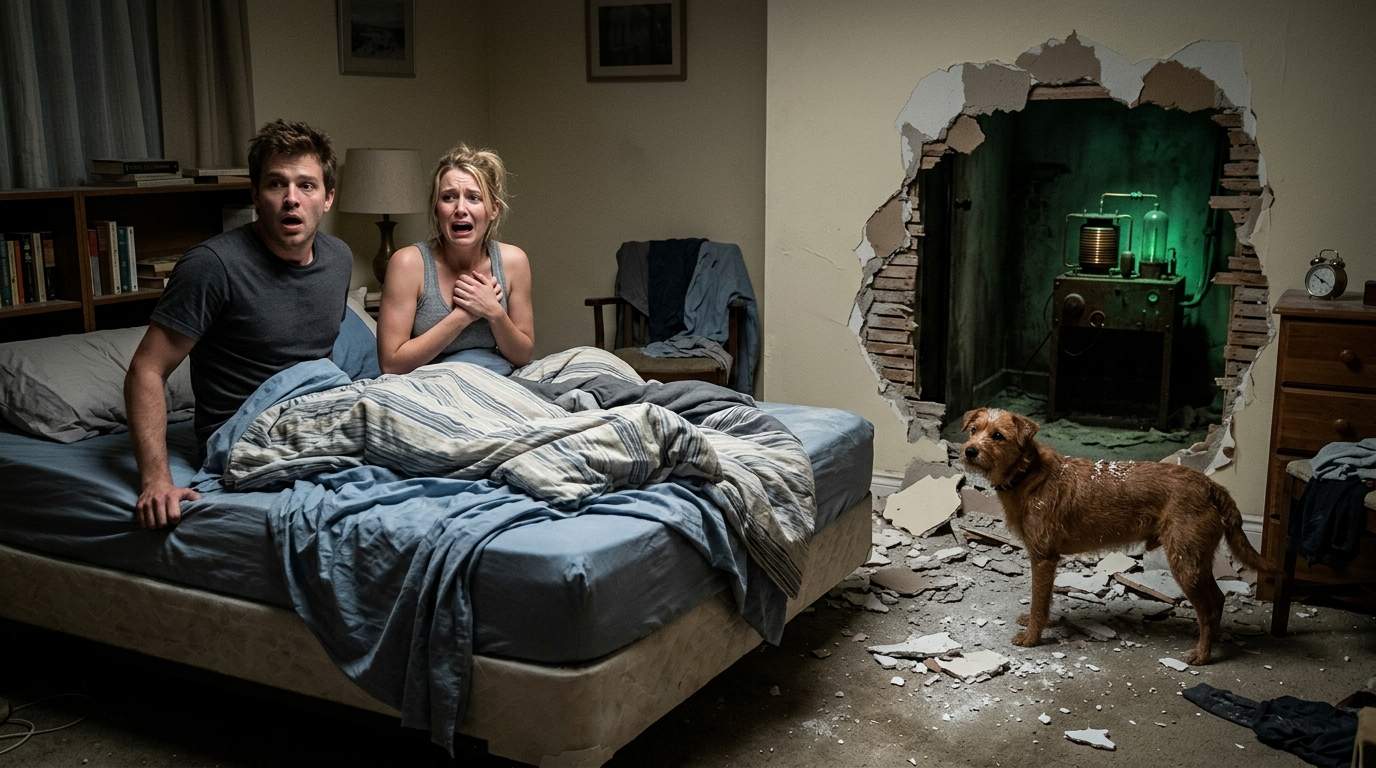
With a deafening roar, a large section of the wall opposite their bed suddenly collapsed inwards.
Plaster, lath, and fragments of the painting exploded into the room, kicking up a thick cloud of dust.
The bed shook violently.
Mark and Sarah scrambled back, clutching each other, coughing as the debris settled.
When the dust began to clear, an gaping, jagged hole stared back at them.
Beyond it lay not just darkness, but a previously unknown space.
A long, narrow passage stretched into the gloom, leading to a hidden, dilapidated room.
A faint, sickly green light pulsed from within, casting eerie, dancing shadows on the exposed studs and crumbling plaster.
The air that wafted from the opening was stale, cold, carrying a metallic scent and something else… something faintly acrid and ancient.
Buster, amidst the scattered debris, was suddenly silent.
His frantic barking ceased entirely.
He stood rigid at the edge of the newly revealed opening, head cocked, his eyes no longer wide with terror but fixed with an unnerving, almost reverent intensity into the green-lit darkness.
He let out a low, almost imperceptible whine, a sound of recognition.
“My God,” Sarah whispered, her voice barely audible, clutching Mark’s arm.
Mark stared, his jaw slack, his mind struggling to comprehend.
Before them, where a plain wall had been moments before, was a secret space, hidden for decades.
The green light pulsed again, illuminating more of the revealed chamber.
It wasn’t an empty crawl space.
It was a small, crudely constructed room, lined with what looked like reinforced steel plates in some areas.
In the center stood a single, archaic device, humming with a low, unnerving frequency, its green light emanating from a complex array of glowing tubes and wires.
Next to it, bolted to the floor, was a sturdy, rusted metal chest, secured with a heavy, old padlock.
The entire hidden space exuded an aura of profound dread and unspoken history.
Grandfather Elias's Legacy
Mark and Sarah, half-dressed and still trembling, eventually mustered the courage to approach the opening.
The air inside the hidden room felt heavy, cold, and strangely charged.
Buster, still silently staring, occasionally nudged Mark’s leg, a silent plea.
Using their phone flashlights, they illuminated the space beyond the green glow.
The walls of the chamber were covered in strange, intricate symbols, etched directly into the steel plates.
They looked like a bizarre fusion of scientific diagrams and occult sigils.
Mark recognized some of his grandfather's idiosyncratic sketches from old notebooks, but never like this.
The metal chest was the most immediate mystery.
With a shard of plaster, Mark managed to pry open the rusted padlock.
Inside, nestled amongst layers of ancient, yellowed blueprints, they found several leather-bound journals.
Grandfather Elias’s distinctive, sprawling handwriting filled the pages.
The first few entries detailed his early experiments, his brilliant but unorthodox theories on "inter-dimensional resonance" and "legacy preservation through energetic containment."
But as they delved deeper, the tone shifted.
The entries became increasingly frantic, obsessed.
Elias wrote about detecting "anomalies," "echoes from beyond," and a singular "sentient entity" he believed he had inadvertently summoned.
He called it the "Observer."
The Observer, Elias claimed, could not physically manifest, but it could perceive, learn, and subtly influence.
He believed it fed on attention, on consciousness, and was drawn to strong emotional signatures.
He wrote about constructing the hidden room, a "containment chamber," and the device – an "etheric stabilizer" – to keep the Observer contained.
“It merely watches,” one chilling entry read, “but it learns. And it desires to cross over.”
Elias had been trying not to communicate with it, but to trap it.
And the bedroom wall? It wasn't just a wall; it was a carefully disguised, reinforced barrier designed to keep the Observer from interacting with the outside world.
Buster’s frantic obsession, his knowing silence now, suddenly made terrifying sense.
He hadn't been reacting to a random presence, but to the Observer itself, sensing its malevolent intelligence contained behind the wall.
He’d been trying to warn them.
The Unspoken Truth
The green light from the "etheric stabilizer" began to flicker erratically.
A low, unsettling hum emanated from it, growing in intensity.
The air in the hidden room seemed to thrum with unseen energy.
Mark’s face was ashen, a mix of horror, guilt, and a dawning, terrible understanding.
His eccentric grandfather wasn't just a quirky inventor; he was a desperate man who had unleashed something unspeakable.
And he had left them to deal with it.
Sarah clutched his hand, her knuckles white.
Her gaze darted from the flickering device to the dark passage, then to Buster, who had now sat down, his gaze unwavering, almost challenging the hidden darkness.
The journals contained a final, chilling warning: "The containment is not permanent. The Observer grows stronger with observation. If the barrier weakens, or if it senses an open mind, it will reach out. Do not acknowledge it. Do not attempt to communicate. For it merely watches, and it learns, and it waits."
The flickering green light cast long, dancing shadows, making the etched symbols on the steel walls seem to writhe.
They were no longer just a young couple in a new home.
They were inheritors of a terrifying legacy, guardians of an unimaginable secret.
The Observer was here, in their home, and now the wall was down.
It had been watching them all along, perhaps even influencing Buster.
And now, it was aware that they were aware of it.
The question hung heavy in the air, unspoken but terrifyingly clear: what would happen when the green light finally went out?
Can you ever truly be safe when something unseen, something ancient, is watching you from within your own walls, silently learning, patiently waiting for its moment to cross over?