You have $15,000 burning a hole in your pocket, and suddenly everyone is an expert. Your uncle swears by Toyota, claiming his 1998 Camry is still running like new. Your friend just bought a 2021 Hyundai Elantra with a giant touchscreen and says you'd be crazy to buy something "ancient." The dealership lot offers a 2014 Corolla with 80,000 miles and a 2020 Elantra with 60,000 miles, both priced similarly, and you find yourself frozen in indecision. This is the classic used car dilemma distilled to its essence: do you prioritize the known quantity, the vehicle with a decades-long reputation for mechanical immortality? Or do you chase the newer model, with its modern infotainment, updated safety features, and remaining factory warranty? The answer reveals fundamental truths about value, risk, and what you actually need from a car.
Let us examine the Corolla case first. A 2014-2015 Toyota Corolla, with mileage between 70,000 and 90,000, sits comfortably in the $13,000-$15,000 range. This generation, the E170, represents Toyota at its most conservative. The 1.8-liter 2ZR-FE engine is a study in mechanical simplicity, with port injection to prevent carbon buildup and a timing chain that will outlast the car. The four-speed automatic transmission in the base L model is an antique by modern standards, but it is also unburstable, shifting with a predictability that borders on agricultural. The interior is built from materials designed to survive a nuclear exchange: hard plastics that won't crack, cloth seats that resist stains, and switchgear that feels the same at 100,000 miles as it did at zero. The driving experience is competent but utterly devoid of engagement. The Corolla floats over highway expansion joints, leans in corners, and generally communicates as little as possible. Its greatest strength is that it will start every morning, in every weather, requiring only oil changes and the occasional set of tires, for another 100,000 miles.
Now consider the alternative. A 2020-2021 Hyundai Elantra, with 50,000 to 70,000 miles, can be found for similar money. This is the seventh-generation model, and it represents a fundamentally different philosophy. The styling is sharp, almost European, with creases and angles that the Corolla's anonymous sheet metal lacks. The interior is a technological showcase: an 8-inch touchscreen with wireless Apple CarPlay and Android Auto, a suite of advanced driver assists including forward collision warning and lane keeping, and a design that feels genuinely modern. The fuel economy is competitive, and the 2.0-liter engine, while not powerful, is willing. The driving dynamics are actually superior to the Corolla, with more precise steering and a chassis that feels tied down rather than floaty. The 10-year/100,000-mile powertrain warranty, if it remains with the car, could still offer coverage for a new buyer.
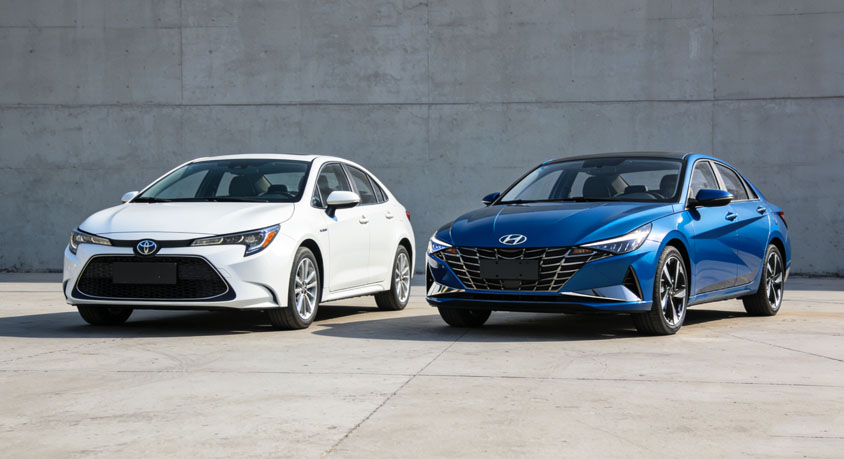
The seduction of the Elantra is the seduction of the present. It feels current, connected, and equipped with features that matter in daily life. The wireless CarPlay means you never fumble with cables. The backup camera is crisper. The blind-spot monitoring could genuinely prevent an accident. The interior is a pleasant place to spend time, with soft-touch materials where it counts and a design that doesn't scream "economy car." For a first-time buyer, especially one coming from a world of smartphones and instant connectivity, the Elantra feels like home. The Corolla, by contrast, feels like a museum piece, a relic from an era when cars were appliances and drivers expected nothing more than reliable transport.
But the trap is sprung in the details. The Elantra's 2.0-liter engine, while adequate, has known issues with piston ring wear in some early examples, leading to oil consumption. The dual-clutch transmission in some variants can be jerky at low speeds. The infotainment system, while modern, can freeze and require resets. The interior, while stylish, develops rattles as the miles accumulate, and the soft-touch materials can wear through on high-contact surfaces. The warranty, while impressive, requires meticulous maintenance records and may not transfer fully to a second owner. The Elantra asks you to trust that its complexity will not become your expense, that the features you love today will not become the repair bills you dread tomorrow.
The Corolla's counterargument is the argument of time. It has no features to fail because it never had them. The infotainment screen, if it exists, is small and slow. The safety features are limited to basic stability control and a backup camera. The interior is an ocean of hard plastic. But the engine will not consume oil, the transmission will not shudder, and the electrical system will not generate ghost codes. The Corolla's value is not in what it does, but in what it doesn't do: it doesn't break, doesn't surprise, doesn't demand more than the bare minimum. It is the car you buy when you need transportation, not entertainment.
The financial math reinforces this divide. A 2014 Corolla, bought today, will likely depreciate slowly, perhaps losing another $2,000 over five years. A 2020 Elantra, having already taken its biggest hit, will still depreciate faster, maybe $4,000 over the same period. Insurance on the Corolla will be cheaper, as it is older and less expensive to repair. Repairs, when they come, will be cheaper, with aftermarket parts abundant and labor straightforward. The total cost of ownership over five years favors the Toyota, sometimes dramatically. The Elantra's lower entry price is eroded by higher depreciation, higher insurance, and the potential for more expensive repairs.
The final decision hinges on an honest self-assessment. If you are the type of person who keeps a phone for three years, who values the latest features, who is willing to accept some risk for a nicer interior and better technology, the Elantra will make you happier every day. If you are the type who keeps a phone until it dies, who views a car as a tool to be used and discarded, who prioritizes low stress and predictable costs above all else, the Corolla is the rational choice. The trap is buying the Elantra thinking it will be as reliable as the Corolla, or buying the Corolla and resenting its lack of features every time you drive. Know yourself, and the choice becomes clear.