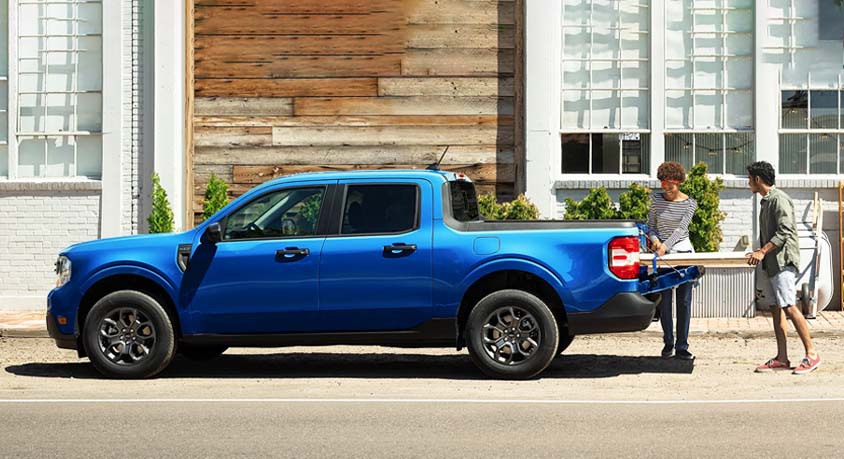
I was at Home Depot loading eight-foot 2x4s into the bed of this Maverick, and a guy in a lifted F-250 Super Duty walked past and actually laughed. He said, “That’s not a real truck,” pointing at the unibody construction and the compact bed like he was delivering a verdict from on high. I asked him how many times in the last year he’d actually used his truck for something that required 1,000 pounds of payload. He didn’t answer. He just got into his pavement princess and drove home to his suburban HOA. That’s the beauty of the Ford Maverick. It’s a truck for people who need to do truck things once a week, not once a decade. And after driving the hybrid version for 500 miles of mixed use—hauling furniture, commuting in stop-and-go traffic, and taking the family to a soccer tournament—I’m convinced Ford accidentally built the most honest vehicle on the market.
The hybrid powertrain is the headline here, and it delivers on the promise in ways that make traditional truck guys uncomfortable. Under the hood is a 2.5-liter four-cylinder paired with an electric motor and a continuously variable transmission. Total output is 191 horsepower, which sounds pathetic until you realize that’s not the point. The point is fuel economy. I averaged 39 miles per gallon over a week of driving that included highway stretches, city gridlock, and a trip to the dump with a trailer full of yard waste. The Toyota Tacoma, which starts at a higher price point, struggles to crack 20 mpg in the same conditions. When I filled up after 450 miles, the pump clicked off at 11 gallons. I spent less on gas than I did on the coffee I drank while driving. For the guy who commutes 40 miles a day but needs to haul a dirt bike on weekends, this math is impossible to ignore.
The CVT is where people get nervous, and I get it. CVTs in Nissan products have given the whole technology a bad reputation. But Ford’s e-CVT, which uses a planetary gearset instead of steel belts, doesn’t have that rubber-band feeling. When you accelerate onto the highway, the engine revs up to its efficient sweet spot and stays there while the electric motor fills in the gaps. It feels more like a smooth automatic than a traditional CVT. The downside? It sounds weird. The engine drones at a constant pitch during hard acceleration, like a generator powering a construction site. It’s not the aggressive growl of a Honda Ridgeline’s V6, which sounds genuinely pleasant when pushed. The Maverick sounds like an appliance doing its job. But appliances are reliable, and that’s the trade-off.
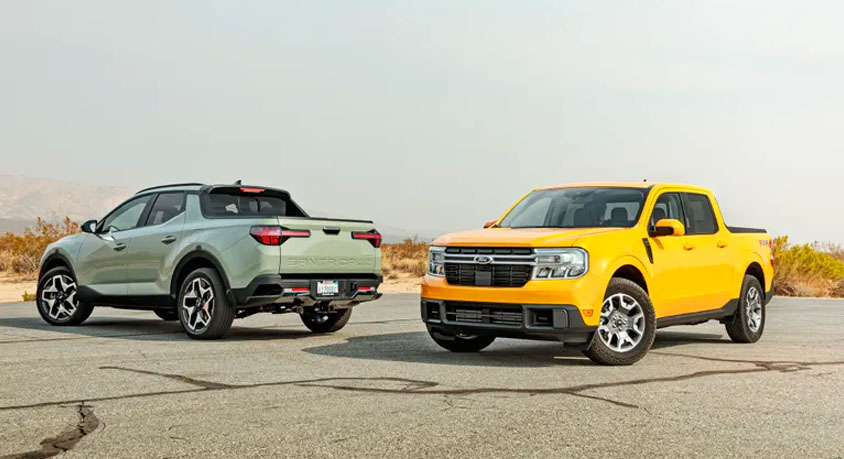
Ford made a decision with the interior that I both respect and despise. The materials are cheap. Hard plastics everywhere, door panels that flex when you lean on them, and seat fabric that feels like it came from a 1990s office chair. But here’s the thing: they didn’t pretend otherwise. There’s no fake wood trim, no piano black gloss that scratches if you look at it wrong. It’s utilitarian in a way that reminds me of pickup trucks from the 1980s. The Hyundai Santa Cruz, which is the Maverick’s only real competitor in this space, has a much nicer interior. Soft-touch surfaces, a more modern infotainment layout, and seats that don’t feel like church pews. But the Santa Cruz starts at a higher price and can’t match the Maverick’s fuel economy. You’re paying for polish. The Maverick gives you function.
The bed is small, and I need to be honest about what that means. It’s four and a half feet long, which is useless for sheet goods. I hauled those 2x4s with the tailgate down and a red flag tied to the end, and it worked fine. But if you’re a contractor who needs to carry drywall every day, you’re buying the wrong truck. The genius of the Maverick is the FLEXBED system. There are slots cut into the bed walls for 2x4s to create dividers, built-in bottle holders that double as tie-down points, and a 400-watt inverter in the bed for running tools. When I was tailgating at my kid’s soccer game, I used the inverter to power a blender for smoothies. The Ridgeline does the same thing with a better implementation—a trunk under the bed floor and a larger overall footprint—but the Ridgeline costs $15,000 more. The Maverick gives you 80 percent of the utility for 60 percent of the price.
The driving dynamics are where the Maverick falls apart if you expect sporty handling. The steering is light, almost too light, with zero feedback through the wheel. When you’re merging onto a cloverleaf ramp, the body rolls like a ship in rough seas. The rear suspension is a torsion beam, not the multi-link setup you get in the all-wheel drive Maverick or the Santa Cruz. It’s fine for commuting, but when I loaded the bed with 500 pounds of topsoil, the rear squatted noticeably and the headlights pointed at the sky. A Tacoma wouldn’t blink at that weight. The Maverick asks you to take it easy.
I brought this truck to my mechanic friend’s garage to poke around underneath, and that’s where the cost-cutting becomes visible. The spare tire is mounted under the bed with a cable winch that feels like it belongs on a lawn mower. The exhaust routing is functional but messy, with welds that look like they were done on a Friday afternoon. The wiring harnesses are exposed in places where road salt will find them in a few winters. Compare it to a Toyota, where everything is tucked away and over-engineered for longevity, and you see where Ford saved money. The Maverick is built to a price, and that price is $25,000 for the base hybrid. In 2024, that’s absurdly cheap for a new vehicle that does this much.
At the end of the week, I parked the Maverick next to that same lifted F-250 in the Home Depot lot. The F-250 costs twice as much, uses three times the fuel, and will never see a job site more demanding than a mulch pickup. The Maverick is smaller, cheaper, less capable in extreme scenarios, and honestly more honest. It doesn’t pretend to be a heavy-duty workhorse. It just does what most truck owners actually need: carries the occasional load, sips fuel the rest of the time, and fits in a standard garage. If you need to tow 7,000 pounds, buy something else. If you need to haul a couch from IKEA without borrowing your neighbor’s truck, this is the answer. Ford didn’t build the best truck. They built the most sensible one. And sometimes, being sensible is the rarest thing on the road.