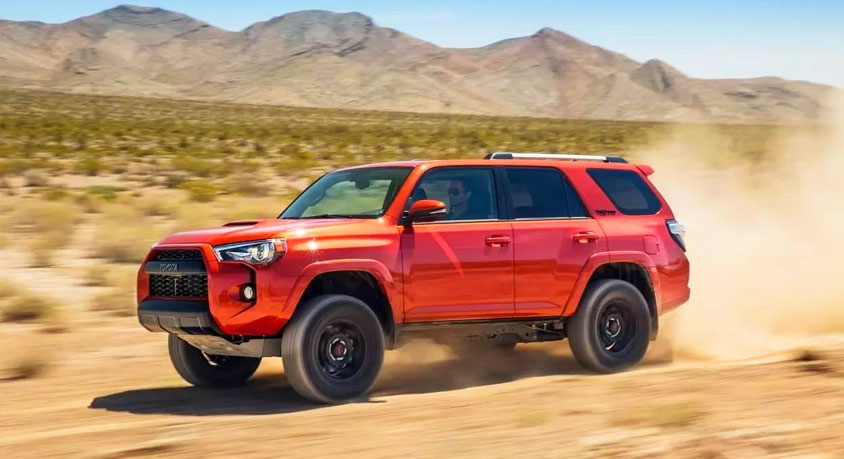
Toyota executives have spent the last fifteen years acting like a homeowner who refuses to fix a leaky faucet because they’ve grown fond of the rhythmic dripping sound. We waited an eternity—literally since the first Obama administration—for a new 4Runner, while the Jeep Wrangler evolved and the Ford Bronco galloped back into the frame with its doors off and its chest puffed out. Now that the 2026 4Runner TRD Pro is finally sitting in my driveway, draped in a color called "Mudbath" that looks suspiciously like a chocolate milkshake left in the sun, I have to wonder if Toyota actually built a better machine or if they just put a digital watch on a caveman.
Sliding into the driver’s seat of the TRD Pro doesn't feel like entering a modern cockpit; it feels like stepping into a well-worn Carhartt jacket. The dash is chunky, the buttons are sized for people who wear work gloves to buy groceries, and the upright windshield gives you a panoramic view of the world you’re about to crush. But the real shock comes when you thumb the starter. There is no lazy, gravelly yawn of the old 4.0-liter V6. Instead, the i-FORCE MAX hybrid powertrain wakes up with a synthetic hum before the turbocharged 2.4-liter four-cylinder kicks in with a sound that’s less "venerable truck" and more "angry lawnmower with a gym membership."
Purists are going to whine about the loss of two cylinders until they hit the gas pedal on an interstate on-ramp. This new heart pumps out 326 horsepower and a massive 465 lb-ft of torque, which makes the old engine feel like it was running on decaf and prayers. When you’re trying to merge into 80 mph traffic on the I-95 with a week’s worth of camping gear and a dog that weighs as much as a small human, the old 4Runner used to scream in agony while barely moving the needle. This 2026 model actually pins your shoulders to the seat. It’s the difference between trying to run through waist-deep water and finally finding the solid ground of the pool deck.
However, the refinement stops at the powertrain. Toyota still insists on using a steering rack that feels like it’s connected to the front wheels by a series of heavy-duty rubber bands. On the highway, you’re constantly making micro-adjustments just to stay between the lines, a tiring dance that the Ford Bronco handles with much more grace. The Bronco feels like a modern SUV that happens to go off-road; the 4Runner feels like an off-road tool that is deeply annoyed by the existence of pavement. If your daily commute involves more than thirty minutes of slab-sided highway driving, the wind noise whistling around those massive side mirrors will eventually start to sound like a personal critique of your life choices.
Take it to Home Depot to load up on bags of mulch or 2x4s, and you’ll appreciate that the rear glass still rolls down—the greatest party trick in the automotive world. But try to toss a heavy cooler into the back, and you’ll notice the high load floor necessitated by the hybrid battery. It’s a compromise that stings. While the Land Cruiser shares this platform and feels like a boutique hotel on wheels, the 4Runner TRD Pro is much more utilitarian, bordering on Spartan. The IsoDynamic seats, with their visible shock absorbers on the back, look like something out of a sci-fi movie. Do they work? Sure, they soak up the bumps when you’re pre-running across a dry lake bed, but they also eat up precious legroom for the poor souls relegated to the back seat.
The TRD Pro’s suspension, featuring those fancy Fox internal bypass shocks, is where the magic happens, provided you aren't on asphalt. Crawling over a rock garden feels less like a mechanical struggle and more like a casual stroll. The Multi-Terrain Select system is now so competent it almost feels like cheating. It’s like playing a video game on "Easy" mode while everyone else is struggling with "Hardcore." Compared to the Jeep Wrangler Rubicon, the 4Runner is significantly more composed and won't give you a kidney stone over a pothole, but it lacks that raw, mechanical soul of the Jeep. The Jeep feels alive; the Toyota feels engineered to survive a nuclear winter.
I still despise the "floating" tablet infotainment screen that looks like an iPad glued to the dashboard as an afterthought. It's a lazy design, and it’s everywhere now. I want a dashboard that feels integrated, not a piece of consumer electronics staring me in the face while I’m trying to enjoy the wilderness. Also, the price tag on this TRD Pro is creeping into territory that used to be reserved for luxury German sedans. Paying nearly sixty thousand dollars for a truck with this much hard plastic in the cabin feels like buying a premium steak and having it served on a paper plate.
Ultimately, the 2026 4Runner is exactly what the cult demanded: a faster, tougher version of the mountain goat they already loved. It hasn't been "softened" into a crossover, and for that, we should be thankful. It’s a specialized tool, a sledgehammer in a world of Swiss Army knives. It’s better than the Bronco at being a reliable long-term partner, but it’s still more archaic than the new Land Cruiser. If you need to get to the top of a mountain and back for the next twenty years without a single warning light on the dash, this is your rig. Just don't expect it to be quiet or particularly polite about it.
The 2026 4Runner TRD Pro is a loud, proud, and incredibly capable dinosaur that finally learned how to run, even if it still refuses to learn any table manners.