Navigating a dense downtown grid during peak hours often feels less like driving and more like solving a spatial puzzle in real-time, where every inch and degree of steering angle counts. The Chevrolet Bolt EUV approaches this puzzle not as a burden, but as its core competency, its 32.8-foot curb-to-curb turning circle acting like a geometric cheat code that allows it to pirouette into parking spots larger sedans must reluctantly pass by. At just 169.5 inches in length, it slots into urban gaps with the discretion of a subcompact, yet its clever packaging and raised roofline offer an interior volume that shames many vehicles with a much larger external footprint, creating a Tardis-like contradiction between its outside dimensions and inside spaciousness.
The steering rack is tuned for city-speed agility, providing a quick, direct response off-center that makes lane changes in tight traffic and navigating cramped parking garages feel instinctive, a stark contrast to the slower, more languid steering often calibrated for highway stability in larger EVs. This is complemented by the standard one-pedal driving mode, activated via a steering wheel paddle, which transforms the kinetic energy of slowing down into battery charge with such aggressive regeneration that the brake pedal becomes largely ornamental in stop-and-go traffic. Mastering this mode turns driving into a rhythmic exercise in energy management, where you modulate your speed and distance with a single pedal, as if conducting the vehicle's momentum with a subtle upward or downward pressure of your foot.
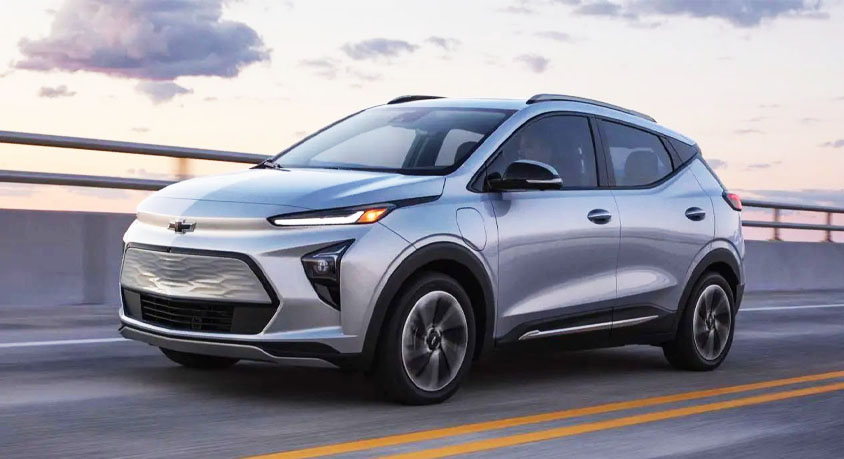
Power delivery from the front-mounted electric motor is immediate and smooth, offering 200 horsepower that feels perfectly suited for darting into fleeting traffic gaps or briskly reaching city speed limits, its silence adding to a sense of calm amidst urban chaos. The seating position, higher than a sedan's but lower than a traditional SUV's, provides a commanding view of the road ahead without the top-heavy feel that can make taller vehicles nervous in quick directional changes. For the core urban mission—the daily commute, the school run, the errand circuit—it executes with an efficiency and ease that can make a more expensive, longer-range EV feel unnecessarily cumbersome and complex.
This hyper-specialization, however, reveals its boundaries clearly once the scenery shifts to open interstate. The Bolt EUV's modest DC fast-charging capability, peaking at 55 kW, means adding substantial range on a road trip requires patience, a slower replenishment rate that feels anachronistic beside 150 kW or 350 kW capable rivals. At sustained speeds above 70 mph, the relative lack of sound insulation and the short wheelbase become more apparent, introducing more road noise and a busier ride quality than on smoothed city streets, while the cabin's minimalist, hard-plastic interior underscores its value-oriented priorities over long-distance luxury.
The vehicle’s true brilliance lies in its self-aware design philosophy. It does not attempt to be an all things to all people, a common pitfall that leaves many vehicles mediocre at multiple tasks. Instead, it focuses laser-like on dominating the specific physics and economics of city driving: compact dimensions, low operating cost, and effortless maneuverability. It asks a provocative question: for the majority of trips that are under 30 miles, often solo or with one passenger, in congestion, why are we driving around so much unused mass and capacity? The Bolt EUV presents itself not as a compromised car, but as a perfectly optimized tool for a defined reality, making a compelling case that the ultimate urban freedom isn't necessarily unlimited range, but the sheer, graceful ability to go anywhere within the city's concrete labyrinth without a second thought.